
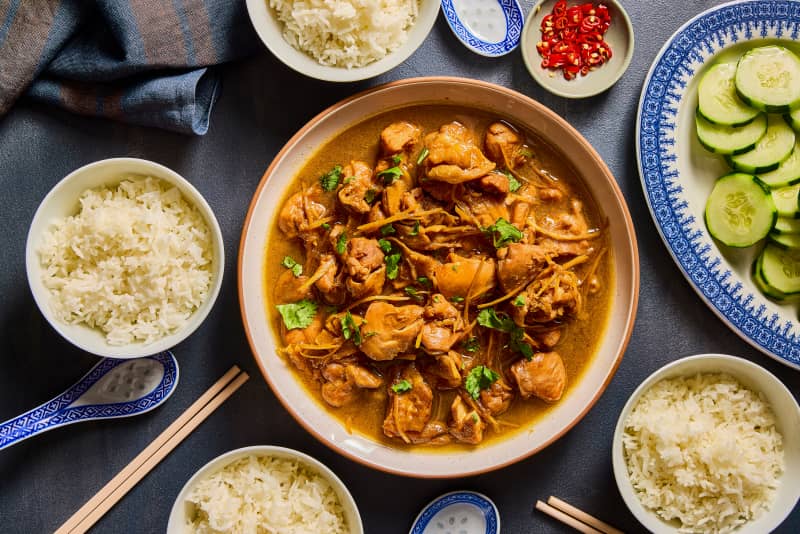
There is a current of bittersweetness that runs through gà kho gừng. The homey braise, in which hearty chunks of chicken (gà) simmer in fish sauce–spiked broth with garlic, shallot, and loads of zingy ginger (gừng), hits first with savoriness, funk, and faint minerality.
And then in seeps the dark, roasty underbelly of nước màu, the tawny caramel syrup that’s a pantry staple in Vietnamese households. Used as a flavor foundation in quick-cooking preparations such as this, it’s a stunning example of what near-burnt sugar can do, bringing an edge of char to the otherwise simple braise and bestowing it with instant, deep complexity.
Sign up for the Cook's Insider newsletter
The latest recipes, tips, and tricks, plus behind-the-scenes stories from the Cook's Illustrated team.

Kho is up there with phở and gỏi cuốn.
—Anh Luu, chef and restaurant owner
For me, gà kho gừng also triggers memories both bitter and sweet. It was routine dinner when I was growing up, my parents, siblings, grandmother, and I using chopsticks to pluck the bits of chicken from a shared bowl, nibbling the tender meat off the bones, spooning the sauce over bites of rice, and interjecting occasional crunches of sliced cucumber.
Making it for myself now, I feel the soothing tug of home and of my grandmother’s food—but also twinges of the shame that creeps into the food experience of so many immigrant and first-generation kids like me who grow up fearing how our family’s food will be received by others.
Particularly the moment when I swirl fish sauce into the braise: As its pungent, fermented aroma wafts up from the pot, all those complicated emotions come rushing back.
But now, years later, my hesitancy is tempered by pride. A few decades ago, I couldn’t imagine sharing this dish beyond my family’s dinner table. Now I’m so glad to imprint it here.
My Grandmother’s Recipe
Gà kho gừng belongs to a broad family of Vietnamese braises called kho (“kho” can also be a verb that more generally means “to braise”). Kho can feature a wide variety of proteins and aromatics—pork belly and hard-boiled eggs, fish, chicken—but the common thread is a comforting, salty-sweet, umami-rich flavor profile generated by braising the components in a combination of nước màu and fish sauce.
“[Kho is] up there with phở and gỏi cuốn,” Anh Luu, chef/owner of Xanh in New Orleans, said in a call about the dish. Andrea Nguyen, James Beard Award–winning author of Ever-Green Vietnamese (2023) and publisher of Pass the Fish Sauce, a Substack newsletter, pointed out its importance at Lunar New Year celebrations in particular. “At Tet, you always have to have a kho,” she said. “Because otherwise you’re just not being very Vietnamese.”
Science: The Savory-Sweetness of Burnt Sugar
The term "nước màu" translates directly to “colored water,” but most cookbook authors refer to this sauce as caramel sauce or burnt caramel sauce. “The flavor is like burnt ends,” Vietnamese cooking authority Andrea Nguyen described. “You just get that umami quality that you would get on the edge of a roast or the tip of a really good piece of chashu pork.”
Nước màu is made by cooking sugar until it breaks down into the simple sugars fructose and glucose, which then break down in turn, creating an array of new aromas and pigments (and water—you can actually see water molecules form and bubble out of the caramel as it cooks).
These compounds, paired with salty, savory fish sauce, create the distinct flavor that unites all kho dishes.
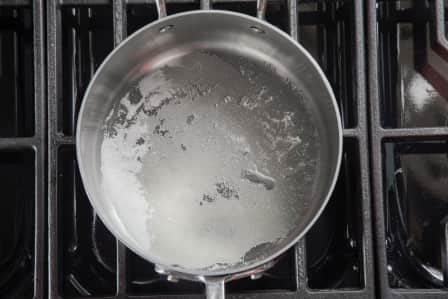
1. The oil will spread as it heats and keep the caramel from sticking to the spatula and saucepan when you stir.

2. When you start to smell the products of the caramelization process and the mixture is honey-colored, lower the heat.

3. Have your aromatics at the ready to toss into the saucepan immediately once the caramel bubbles and becomes soy sauce–colored.
My grandmother’s gà kho was old-school. She used her cleaver to prep all the components, slicing garlic and shallots, smashing some ginger and julienning the rest, and breaking down a whole chicken into bite-size pieces.
First into the pot were a drizzle of oil and the aromatics. Then she’d add the chicken—bones, skin, and all—and cook it until it lost its pink color. Last in were the liquids: a drizzle of nước màu, a few generous shots of fish sauce, water, and a couple splashes of Coco Rico, the Puerto Rican coconut soda that she used because the more traditional coconut water wasn’t widely available in the United States yet. The soda infused the whole dish with a distinct sweetness.
The chicken braised, uncovered, until tender. She’d start tasting it after about 20 minutes of cooking, and it was done when the sauce seemed salty on its own but perfectly seasoned when drizzled over a bite of steamed white rice.
My Tweaks to Her Formula
My grandmother made kho so often that she would make the caramel in big batches, stashing it in a repurposed hoisin jar alongside the fish, soy, and oyster sauces in the pantry. When it came time to make a batch of gà kho, she’d unscrew the lid and scoop out a couple tablespoons using the trimmed-down plastic spoon she stored inside the jar.
I wanted this recipe to be accessible for cooks who don’t keep nước màu on hand, so I needed to work out a way to make a small batch of the caramel, just enough for a single pot of gà kho. There were three potential avenues to take.
I could make a dry caramel as my grandmother did, simply melting and browning the sugar by itself in a pot. But this method can be tricky if you’re not a caramel pro like she was: Depending on how the sugar beads as it melts and how evenly your cookware heats, you can end up with lighter and darker spots of caramel that stick to your spatula as you try to stir them together.
An easier option is a wet caramel, an approach in which you dissolve sugar in boiling water and allow the water to cook off, leaving a sugar syrup that then caramelizes. However, while I like this approach for a large amount of sugar, it’s not ideal for a small batch—as the sugar caramelizes, you can encounter the same unevenness issue.
The method I like best for this recipe is to simply add some oil to the pot along with the sugar. It’s more forgiving because the oil coats both the spatula and the bottom of the pot, making it easier to stir and helping the sugar caramelize evenly.
I added the sugar and then drizzled a couple teaspoons of oil into my saucepan, shaking to spread it into an even layer. I watched as the sugar began to change color.
When I was first learning to cook from my grandmother, this was my job: I’d hop on a chair, watch the crystals melt, and alert my grandmother the moment the liquid turned from clear to pale yellow.
Once the nước màu took on color, I started stirring and then turned down the heat, watching for the caramel to burnish to the color of soy sauce. I stopped it from burning by immediately adding the chopped aromatics to the saucepan.
From there, I proceeded as my grandmother did. I slid in the chicken—I used deboned thighs rather than a whole bird because they’re easier to prep and eat, but I retained the skin for collagen—and cooked the pieces until they were no longer pink.
In went the fish sauce and coconut water (I swapped it in for the soda/water combination my grandmother typically used to gently dial back the dish’s sweetness), and then I let the chicken braise for about 30 minutes.
This braising period is an opportune time to prep your garnishes and accompaniments: fragrant steamed rice, cucumber slices (always, in my house, with the skin removed in stripes), sliced Thai chiles, and cilantro.

Gà Kho Gừng (Vietnamese Caramel-Braised Chicken with Ginger)
Refreshing zaps of ginger punctuate tender, savory pieces of chicken in this simple, cozy braise from the Vietnamese home cooking canon.
Get the Recipe
Gà Kho Gừng (Vietnamese Caramel-Braised Chicken with Ginger) For Two
Refreshing zaps of ginger punctuate tender, savory pieces of chicken in this simple, cozy braise from the Vietnamese home cooking canon.
Get the Recipe