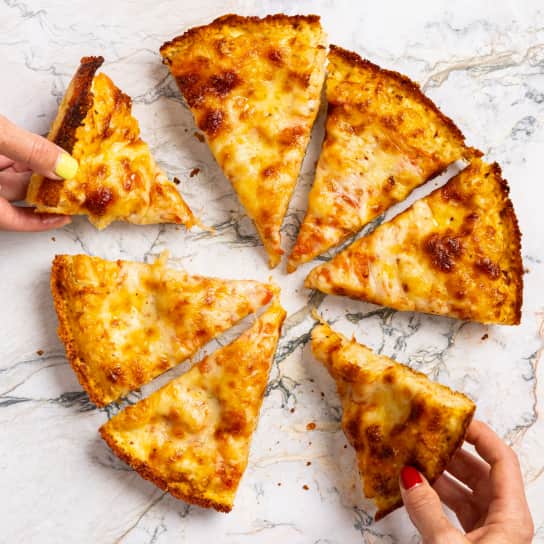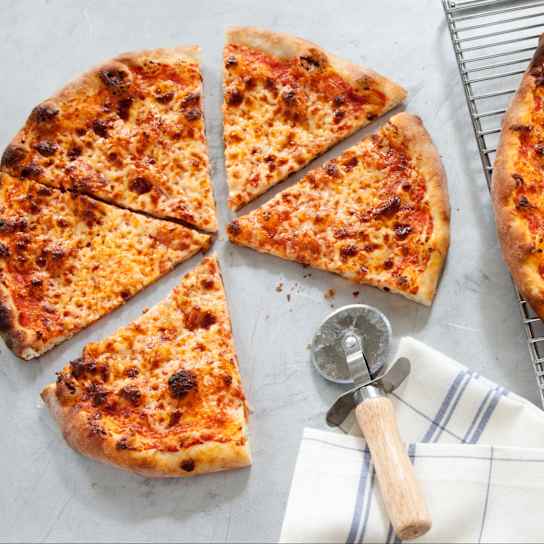

You’re never far from a pizzeria in Buenos Aires. Scattered throughout the streets in the South American capital, these casual eateries are crowded with locals hunched over counters, sipping beers or sweet moscato and using knives and forks to attack slices unlike any other in the world’s pizza canon: spongy, tall, topped with olives and spotty-charred onions, and oozing lava flows of melted cheese.
This is fugazzeta, the over-the-top behemoth of a pizza beloved across Argentina.
Part of the broad category of Argentine pizza known as pizza de molde (“pizza in the pan”), the pie supposedly came about when baker Juan Banchero, whose family was one of many that immigrated from Italy to the region around the turn of the 20th century, tried to salvage a too-dry focaccia by stuffing it full of cheese.
Over time, the dish developed its distinct traits: two layers of fluffy, thick crust sandwiching a gooey cheesy center and topped with a mountain of sliced onions and a garnish of olives.
Sign up for the Cook's Insider newsletter
The latest recipes, tips, and tricks, plus behind-the-scenes stories from the Cook's Illustrated team.
How Pizza Arrived in Argentina

After the unification of Italy in the 1860s and ’70s, many Italians left the nation due to political differences or poor living conditions. As one of the wealthiest nations in the world thanks to its meat and wheat industries, Argentina was an enticing destination.
About 2 million Italians moved there between 1880 and 1920, and they brought their culinary traditions with them, including Neapolitan pizza and Genoese focaccia, forming the foundation for the robust Argentine pizza culture of today.
Fugazzeta’s Foundation
Fugazzeta is typically made with a simple dough of flour, water, sugar, and yeast. The dough, which bakes up bubbly and plush on the inside but crisp on the bottom and sides (much like focaccia), is kneaded, proofed, and split into two portions.
One part is placed in a heavy, high-sided pan and topped with an ample amount of a mild, ultrastretchy cheese, often Argentine queso de barra.
The second dough round is placed on top of the cheese, and its edges are pressed together with the bottom layer’s edges to enclose the cheese inside the dough.
Generous handfuls of sliced onions seasoned with pepper flakes, oregano, and salt are scattered across the top of the dough, and the pizza is baked in an oven until the onions collapse and deeply brown, the crust is fluffy and crisp, and the cheese is melted.
Technique: Assembling Fugazzeta
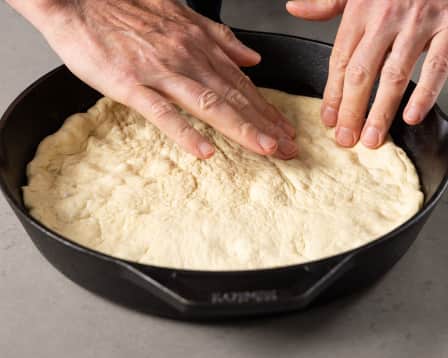
1. Press two-thirds of dough into cast-iron skillet.
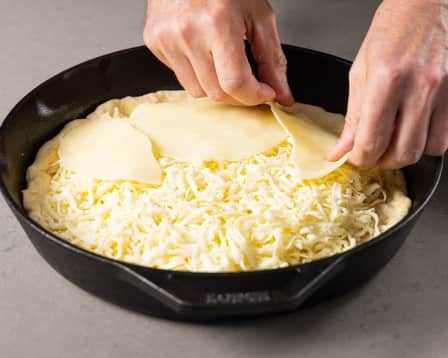
2. Top with shredded mozzarella and sliced provolone.
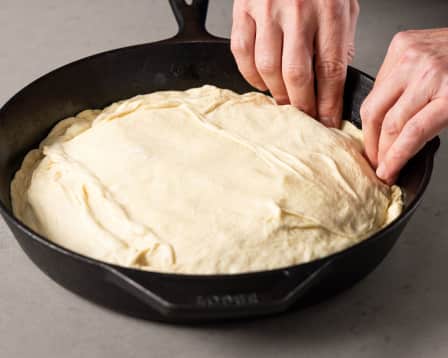
3. Place remaining dough atop cheese. Press to seal.
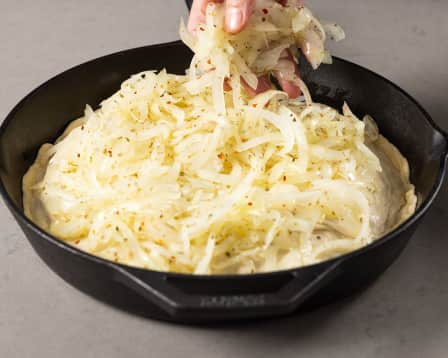
4. Scatter seasoned onions in even layer.
I knew I wanted my fugazzeta dough to be more hydrated than a conventional Neapolitan pizza dough—during baking, that extra water would turn to steam and open up the crumb—but I also wanted to make it as manageable as possible since I knew I’d need to divide and shape it.
Incorporating an autolyse phase, a brief rest after stirring together the dough ingredients, would help: Autolyse allows the flour’s enzymes to snip and uncoil the gluten’s proteins so that they can better line up, making the dough firmer and easier to work.
After mixing in the salt (I withheld it during the autolyse because it inhibits enzymatic activity) and kneading the dough, I split it into two portions to form the pizza’s top and bottom crusts. Some recipes split the dough in half, but I liked the idea of using two-thirds of the dough for the bottom crust and one-third for the top—the thicker bottom crust would provide a sturdy base for lots of cheese.
When the two balls of dough had doubled in size, I prepared for assembly by coating the bottom of a cast-iron skillet with a generous amount of oil. In the oven, the bottom dough would essentially fry in the oil, bronzing and crisping. I gently coaxed my larger dough ball into a 12-inch round and then eased it into the skillet.
Now, it was on to the cheese

Bread Illustrated
Our first cookbook devoted solely to bread baking highlights more than 100 meticulously tested recipes that will enable you to bake artisan bakery–quality bread at home.
Buy NowA Cheesy Center
Mozzarella is a common alternative to queso de barra that I was happy to adapt here. It’s an exceptional melter, especially whole-milk mozzarella: Its pH is in the sweet spot for melting, so the cheese’s protein structure hangs together loosely and flows readily when heated. I shredded a 12-ounce block and then buried the dough in the skillet beneath a blizzard of shreds.
While mozzarella provides the dish’s signature extensibility, its flavor is tame, and I found myself wanting some extra sharpness. Slices of provolone, though less traditional, fit the bill: The aged, salty tang of the cheese added depth, and shingling a few slices right on top of the shreds leveled the top of the cheese layer, making it easy to place the second layer of dough on top.
I stretched the smaller second portion of dough over the top of the cheese to the edges of the skillet and pressed the two layers together. Then, I topped the dish with a heap of seasoned raw onions and slid the skillet into the oven.
Science: Prepare Your Oven for Pro-Caliber Fugazzeta

The bronzed, crunchy crust; gooey melted cheese; and spotty-brown onions that define fugazzeta are largely products of the squat ovens used in Argentine pizza shops. In those ovens, heat rises from a flame at the bottom, deeply browning and crisping the pizza’s crust, and is absorbed by the oven’s domed top, which then radiates the heat downward to quickly melt the cheese and lightly char the onions on the top of the pie.
Fortunately, we were able to approximate that setup in a conventional oven with the following steps.
1. Place the oven rack 6 inches from the ceiling element so that the food is close to the element’s radiant heat.
2. Preheat the oven to 450 degrees to increase the oven’s convective heat, and then heat the broiler for 5 minutes to maximize the heat beating down on the cheese and onions.
3. Return the oven temperature to 450 degrees and bake the pizza.
Perfecting the Cook
When I pulled the pan out, the cheese was melted and the bottom crust was browned, but the top dough was stodgy and undercooked, and the onions weren’t as browned as I had hoped.
I realized the raw alliums were releasing water as they cooked, sogging out the top crust and impeding their own browning. So I decided to pretreat them with salt and squeeze them out after a rest.
Sure enough, I was able to squeeze about ½ cup of liquid from the 1½ pounds of onions.
The concentrated onions made a big difference, but the top layer of dough was still slightly undercooked. So I made one more adjustment: I moved my oven rack up, about 6 inches from the top. Fugazzeta is typically cooked in squat pizza ovens, so the top layer of dough is close to the intense radiant heat at the top of the oven.
Moving the oven rack would help replicate this, as would preheating the broiler and then turning it off right before I slid the pizza in.

Sure enough, when I pulled the fugazzeta from the oven 40 minutes later, the bottom crust was golden and crisp, and the top was slightly puffed beneath the layer of charry onions and the olives I added as a garnish.
When I cut myself a slice, I knew I had it right: The cheese extended into stretchy ropes as I lifted the slice and set it on my awaiting plate. Let the pizza party begin.
Special thanks to pizza maker Fernando Greco (og_papafern) for providing background information on fugazetta for this story and my recipe.

Fugazzeta (Argentine Cheese-Stuffed Pizza)
Argentina’s fugazzeta layers plush dough with gobs of melty cheese and blistered onions.
Get the Recipe