
Side by side in the test kitchen, Cyroos Rahravan and I methodically washed, dried, and picked our way through heaps of fresh parsley, cilantro, and dill while he told me about Nowruz.
The word means “new day” in Farsi (its spelling and pronunciation can vary), and the 3,000-year-old cultural holiday to which it refers, also known as Persian New Year, marks the first day of spring.
“Everybody’s waiting for that hour, that minute,” said Rahravan about the vernal equinox, the point at which the sun is equally aligned over the northern and southern hemispheres, kicking off the holiday like nature’s own New Year’s Eve ball drop. “Now, it’s Nowruz,” he said. “Now it’s spring.”
Sign up for the Cook's Insider newsletter
The latest recipes, tips, and tricks, plus behind-the-scenes stories from the Cook's Illustrated team.

Iranian cuisine is mostly herbs.
——Cyroos Rahravan, Iranian home cook
Rahravan, who is from Tehran and is the father of my test kitchen colleague Emily Rahravan, explained that the two-week holiday is spent with loved ones, eating symbolic foods such as the kuku sabzi we were making.
Kuku, the savory Persian cake that’s often likened to frittata but contains much less egg, can feature all sorts of vegetables (potatoes, eggplant, zucchini, beets), but this most iconic version is all about the herbs (“sabzi” means “greens”), specifically the ones we were prepping, as well as leek, green garlic, or scallion and sometimes romaine.
The greens are chopped fine and then mixed with just enough egg to bind them together (other additions can include spices such as turmeric or dried fenugreek; baking powder to give the cake loft; zereshk, which means “barberries” in Farsi; and chopped walnuts) before the thick, grass-green mixture is poured into a hot, oil-slicked skillet and sizzled on the stove.
When the cake is set and the underside deeply browned, it’s inverted onto a plate (or cut into wedges for easier handling) and returned to the pan to color the other side.
That browning tastes deeply of allium savor, while the interior, which is moist and tender with a hint of bounce, bursts with herb flavor as bright and grassy as its vivid green color suggests.
During Nowruz, that herbaceousness—a symbol of rebirth and renewal—also appears in sabzi polo, the rice dish flecked with the same herbs, and complements the smoked and fried white fish that shares the table. But kuku sabzi is ubiquitous in Iran year-round, particularly at sandwich shops that slip a slice of the cake into a split roll with tomatoes, pickles, and onion.
“You can eat it any time of year,” said Farideh Sadeghin, the New York–based food writer and recipe developer who grew up eating kuku. “You should eat it any time of year. It’s great all the time.”

Gatherings
More than 25 ATK pros and cooks reveal their favorite ways to gather with friends and family. Learn their personal recipes and stories, playful menus, and practical game plans and tips to make your gatherings go smoothly.
Shop NowGreen Cuisine

“Iranian cuisine is mostly herbs,” said Cyroos Rahravan, a Tehran native and home cook, as he described the greens’ ubiquity in the cuisine. Cilantro, dill, parsley, basil, mint, and more are sold by the kilo at produce bazaars and are the center of dishes like kuku sabzi, sabzi polo (rice), and ghormeh sabzi (stew). (“Sabzi” means “greens” in Farsi.)
More than anything, they’re enjoyed as sabzi khordan: the platter of whole “herbs for eating” that sometimes includes radishes, scallions, cucumbers, and/or walnuts and anchors every Persian meal.
“We’d be eating rice and stews, and then we’d just take handfuls of the fresh herbs and shove them into our mouth,” said food writer Farideh Sadeghin, remembering childhood family meals. Nowadays they’re her default addition to salads and sandwiches. “I want to put fresh herbs on everything.”
Go Green
In Iran, where herbs are abundant and essential to the cuisine, dedicated herb stalls not only supply cooks with greens but also finely chop them to order for kuku and other herb-based dishes.
You need lots to make a kuku that’s vividly green and impressively tall, and you need to diligently dry and chop them to ensure that the cake’s texture is light.
To fill a 10-inch skillet (nonstick, to easily turn out the kuku), I finely chopped between 9 and 10 cups of greens: a couple cups each of parsley and cilantro; half as much dill (its flavor is strong); a couple more cups of romaine, which added airy structure and clean, neutral flavor to balance the more assertive herbs; and a large leek plus plenty of minced garlic, which brought sugars and sulfur compounds that turned wonderfully complex and savory when browned.
How to Chop a Big Batch of Herbs
Chopping lots of leafy herbs by hand can be time-consuming, but it’s a useful skill to have—especially when prepping herb-heavy dishes such as kuku sabzi and tabbouleh, where drier, fluffier, more uniform greens lead to a lighter-textured finished product. This method makes the task more efficient.

BUNDLE Gather washed, dried herbs (as much as you can comfortably hold) into a tight pile with your nonknife hand.

ROUGHLY CHOP Using sharp chef’s knife in a rocking motion, slice herbs thin, working your way through pile. Turn sliced herbs 90 degrees and repeat.

FINELY CHOP/MINCE Place fingers of nonknife hand flat on top of knife’s tip and, moving blade up and down with other hand while using knife’s tip as a pivot, chop through pile until herbs are as fine as desired.
Sadeghin described the herb prep as “a labor of love,” particularly the knife work. She stressed that hand chopping the greens produces herbs that are drier and finer, leading to a lighter kuku—and after comparing kuku made from herbs that I’d chopped by hand to a batch made with herbs that I’d pulsed in the food processor, I had to agree.
Chopping with a sharp knife allowed me more control over the herbs’ fineness and yielded more uniform results, whereas pulsing in the processor yielded herbs that were bruised and damp, resulting in a denser kuku. Then I mixed in six whisked eggs seasoned with salt and pepper, which was just enough to bind the greens into a thick, verdant batter.
A Slow Sizzle
Contrast between the brilliant green interior and the richly browned exterior is a kuku hallmark, though cooking it through without burning the outside is a delicate balance.
The key is ample fat in the skillet and steady, moderate heat. I warmed a few tablespoons of oil until it shimmered and then added a small portion of the batter to make sure it sizzled—proof that the skillet was hot enough to cook.
Then I poured in the rest and smoothed the top; covered the skillet to envelop the kuku in steam that encouraged it to cook through quickly and evenly from top to bottom; and reduced the heat, rotating the pan every few minutes, so that the oil actively but gently sizzled at the edges.
About 20 minutes later, the kuku was set and the outer edges were browned, at which point I inverted it onto a plate.
I added a bit more oil to the pan; slid the kuku back in, tucking the edges so it maintained its round shape; and let it sizzle for roughly 10 minutes more to thoroughly brown the second side.

After turning it out of the pan, I gave the kuku 5 minutes to cool and set before cutting a wedge—though it is just as nice to eat at room temperature. The cake stood tall thanks to the abundant herbs (no leavener required), and its mahogany-to-green color contrast previewed its taste: deep, complex savor from the browned alliums and egg giving way to a burst of freshness from the herb-dense interior.
Eating the kuku reminded me of that moment every year on the verge of spring when I look out at my yard, anxious for the first buds of the season to break through the ground. It also reminded me of what Sadeghin mused as we were talking about how kuku ushers in the season.
“When you think about it,” she said, “you wonder, ‘why doesn’t everyone celebrate New Year on the first day of spring?’”
Sandwich Your Kuku

In addition to its prominent role at a Nowruz feast, kuku sabzi is served year-round at sandwich shops throughout Iran, where slabs of the verdant herb cake are wedged between halves of a split roll with tomatoes, khiar shoor (Persian pickled cucumbers), and onions. But a kuku sandwich is easily customizable by changing up the bread (wraps work well too) and condiments.
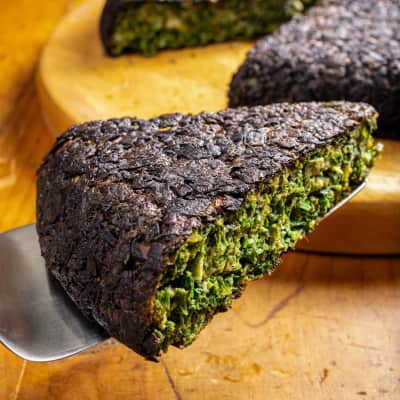
Kuku Sabzi for a Crowd
Packed with verdant greens and sizzled until bronzed, this savory herb cake ushers in the Persian New Year.
Get the Recipe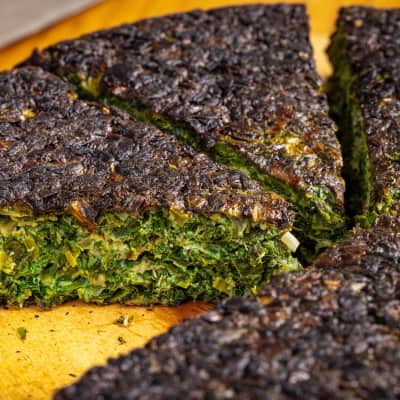
Kuku Sabzi
This savory herb cake—packed with verdant greens and sizzled until bronzed—ushers in the Persian New Year.
Get the Recipe