


While it’s been years since I first tasted okonomiyaki during a trip to Japan, I’ve never forgotten how unique and comforting it is.
Sign up for the Cook's Insider newsletter
The latest recipes, tips, and tricks, plus behind-the-scenes stories from the Cook's Illustrated team.
The savory pancake, cooked on a hot teppan (iron griddle), is a generously topped, crisp-on-the-outside, creamy-on-the-inside mash-up of all sorts of chopped vegetables and proteins.
It’s a hearty, nourishing dish that’s fun to eat and quick to cook, and there are few recipes I can think of that offer so much reward for so little effort.
Okonomiyaki emerged during World War II.
At the time, imported rice made up a large part of the Japanese diet, and when those imports became severely limited during the war, cooks had to turn to wheat flour as an alternative carbohydrate. Okonomiyaki allowed them to stretch flour and whatever odds and ends they had on hand into a filling, sharable meal.
Today, okonomiyaki can be found at casual restaurants and street stalls, but it’s also still a go-to meal or snack for many Japanese cooks, who adapt it to their palates and whatever they have in their refrigerators (the term “okonomiyaki” translates to “what you like, grilled”).
Around the Teppan

In Osaka, okonomiyaki falls under the category known as B-kyu gurume, or “B-grade gourmet”—affordable, hearty, crowd-pleasing comfort foods. At a classic okonomiyaki restaurant, customers might be seated at a bar that wraps around a large grill or at a table with a built-in teppan, allowing them to watch (or participate) as their okonomiyaki are assembled, cooked, and then sliced and served piping-hot.
A Variety of Mix-Ins
In Japan, there are two different types of okonomiyaki: Osaka-style, in which the ingredients are distributed evenly throughout the pancake, and Hiroshima-style, in which the filling and batter are layered.
I opted for the more rustic former, which offers different arrays of textures and flavors in every bite.
Cabbage is the only must-have component of okonomiyaki: The pancake is just as much cabbage as it is batter. I chopped the brassica into ½-inch pieces, small enough to disperse throughout the batter but large enough that the pieces would offer noticeable bite.
From there, the mix-ins are largely up to personal taste: Visit an okonomiyaki restaurant in Japan, and they’ll often offer dozens of different options, from shrimp, squid, or chicken to bean sprouts, mushrooms, or carrots.
For this recipe, I included pork belly for savor and bulk, scallions for their fresh allium bite, and beni shoga for zippy and refreshing flavor.
All of the components would have plenty of time to soften and cook through in the pancake, so none of them needed any prep beyond simple knife work.
Yamaimo’s Slippery Texture

Yamaimo, also known as mountain yam, is an edible tuber popular in Japanese cuisine. Most commonly, the raw yam is grated (it’s a good idea to wear gloves while peeling the yam because its peel can irritate the skin) to form a slippery, frothy white paste known as tororo that’s enjoyed as a delicacy in its own right or served as a topping for soups, fish, and rice. Its unique texture is due to an abundance of long polysaccharide chains known as mannans that form a mucilaginous gel when dissolved in water. This texture also makes it valuable as a binder for okonomiyaki. When it’s incorporated into okonomiyaki, the slippery texture vanishes, but the sticky mucilage holds on to small air bubbles, giving the cooked fritter a tender and fluffy bite.

Batter Up
To bind my okonomiyaki, I mixed up a basic batter of flour, eggs, salt, and savory dashi. Dashi (the ubiquitous Japanese stock made from kombu and katsuobushi) infuses the entire pancake with rich umami, and since only a small amount is needed, a quick version made with instant dashi powder works just fine.
To create the creamy, custardy interior of the okonomiyaki I had in Japan, I knew I’d need the traditional addition of yamaimo, Japanese mountain yam, in my batter.
The root vegetable is one-of-a-kind; when grated, it collapses and becomes slippery and mucilaginous. Three tablespoons of the grated yam ended up being just right: More than that, and the yamaimo’s slipperiness overwhelmed the pancake, but less made for a denser and drier final result (while the effect of yamaimo is unique, adding a few tablespoons of potato starch to the batter instead can have a similar tenderizing effect).
I mixed my prepped ingredients into the batter, ensuring that all the components were evenly dispersed, and then it was time to cook.
Cook and Flip
To replicate a hot teppan, I used a cast-iron skillet, which could build up plenty of heat to brown the exterior of the pancake, caramelizing any of the cabbage or meat that made contact with it.
I preheated the skillet over a medium flame and then turned it down and added a generous slick of oil to keep the okonomiyaki from sticking. Once it shimmered, I added the batter, spreading it into a large, craggy circle. I placed a lid over the skillet to capture moist heat so that the pancake wouldn’t dry out and then allowed it to cook for about 10 minutes, rotating the skillet once to encourage even browning.

Top It All Off With
- Homemade okonomiyaki sauce: Sweet, savory, and tangy
- Kewpie mayo: Slightly richer and more savory than American mayo
- Katsuobushi: Super-savory wisps of dried, smoked skipjack tuna
- Aonori: Briny flakes of dried seaweed
- Beni shoga: Bright, crunchy ginger marinated in plum vinegar
Flipping the okonomiyaki may seem daunting, but it’s easy to do with some strategy.
Once the pancake has built up a robust crust on its first side, simply slide it out of the skillet onto a plate, top it with another plate, invert the stack, and slide the okonomiyaki back into the skillet, browned side up.
After about 10 more minutes of cooking, both sides of the okonomiyaki were brown, and the inside was fluffy, creamy, and tender. I slid the pancake onto a serving plate and added my toppings.
First, I slathered it with a sweet and tangy homemade okonomiyaki sauce made from ketchup, Worcestershire sauce, soy sauce, and sugar. Then I added a zigzag of savory Kewpie mayonnaise, sprinkles of wispy katsuobushi and aonori, and more beni shoga. The okonomiyaki looked as dynamic as it tasted—each bite was packed with layers of umami, salt, brightness, brininess, and sweetness.
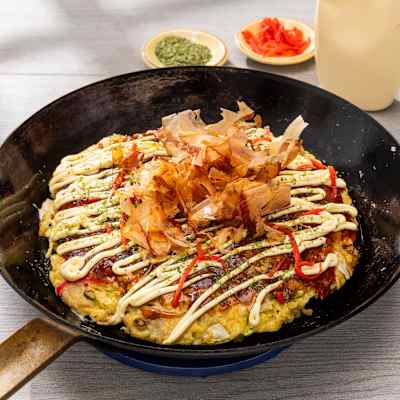
Pork Belly Okonomiyaki (Japanese Cabbage Pancake)
Recreate this Japanese street food in your home kitchen.
Get the Recipe
Shrimp Okonomiyaki (Japanese Cabbage Pancake)
This shareable savory pancake is packed with cabbage and shrimp and garnished with gusto.
Get the Recipe