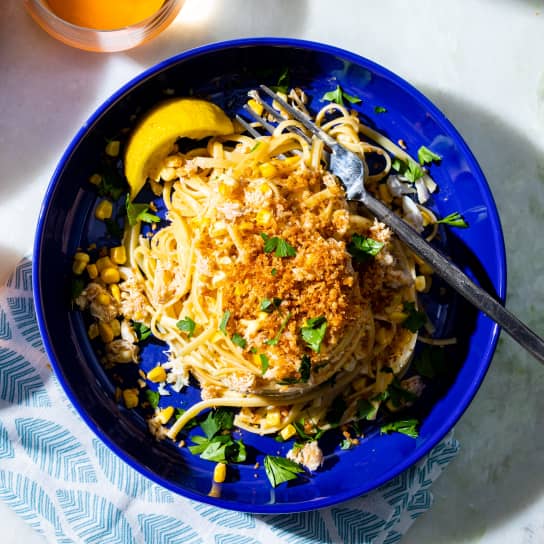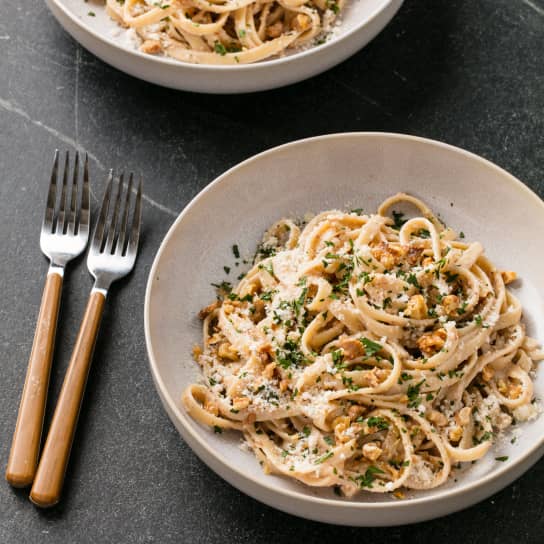

Cacio e pepe makes so much of so little. Like Rome’s other great pasta traditions—pastas alla gricia, amatriciana, and carbonara—cacio e pepe is the magnificent sum of few humble parts.
But the feat is at its most impressive here, in the recipe with the sparest ingredient list: just strand pasta, its cooking water, coarse black pepper, and handfuls of Pecorino Romano. Unlike in those other dishes, there is no meaty funk from guanciale, no brightness from tomato, and no richness from egg—and it only takes one bite to understand why none of that is necessary in this formula.
When tossed together with care, these components transform into a mirror-glossy sauce that’s plenty complex all on its own, grounded by earthy savor and prickling with fruity heat.
Sign up for the Cook's Insider newsletter
The latest recipes, tips, and tricks, plus behind-the-scenes stories from the Cook's Illustrated team.
The secret to this transformation is emulsification: the mixing of two ingredients, the starchy water and the sharp sheep’s cheese, that ordinarily resist each other.
When the water and cheese are forcibly combined, they become a silky, full-bodied sauce that coats each strand of pasta—or at least in practiced hands they do. The truth is that building this emulsion is a finicky process that can all too easily produce a clumpy, watery mess.
Many recipes nowadays thus include some butter, olive oil, or even cornstarch to aid in the emulsification process and guard against this unappetizing result. But these extra ingredients can mask the funk and spice that make the dish so special. I wanted a purist’s take.
Toast and Coarsely Grind the Pepper


The payoff is great when you toast black peppercorns (we use the same Dutch oven we’ll use to cook the pasta) and then grind them using a mortar and pestle. Toasting imparts darker, roastier flavors to the peppercorns and also helps force flavorful oils from their interiors to their surfaces, which makes the pepper taste more robust. When you bite into a coarse ground, you’re hit with a burst of that piquant complexity.
Too Hot; Too Cold
The simplest recipes for cacio e pepe go like this: Boil tonnarelli (a noodle similar to spaghetti, but with a square rather than circular cross section) until just shy of al dente and then slowly incorporate the Pecorino, the pepper, and some of the cooking water into the drained pasta, tossing until the water and cheese form a sauce.
Secret Emulsifier: Superstarchy Water

Cooking the pasta in half the standard amount of water creates a concentrated starchy liquid that thickens the cheese sauce and helps prevent the emulsion from separating.
The challenge here is that there’s only a narrow temperature window in which the pasta water and Pecorino will combine smoothly: The cheese needs to be warm enough to loosen its protein matrix so that the water can be incorporated to form a sauce but not so hot that the proteins in the cheese overheat and clump.
Creamy Cacio e Pepe Is All About Temperature Control
Tossing pasta with its cooking water and Pecorino by hand to try to make a smooth, creamy sauce is traditional but tricky. Not only do you not have any other emulsifying agents, such as added starch, in the mix, but you’re also using a dry, crumbly cheese that doesn’t flow when heated. If the cheese doesn’t get warm enough (at least 145 degrees), its protein matrix won’t loosen enough to incorporate water and turn into sauce. But if the cheese gets too hot (above 180 degrees), it separates into a greasy, clumpy mess. Here are three techniques we used to ensure that the pasta always stayed within its ideal temperature window.

1. Process cheese with hot water: Blitzing the grated cheese with hot water warms it enough to create a smooth paste that can be thinned into sauce when combined with the pasta and its cooking water.
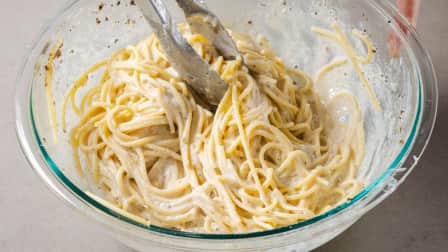
2. Toss components off the heat: Transferring the cooked pasta to a bowl and tossing it with the cooking water and cheese paste off the heat ensures that the sauce won’t get too hot and break.
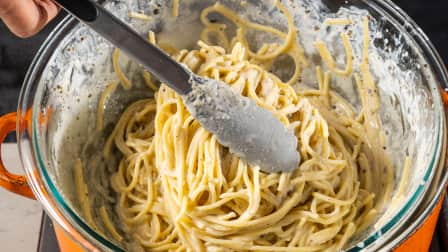
3. Gently reheat if necessary: If the pasta and sauce cool too much during tossing, placing the bowl over the pot of still-steamy pasta water gently rewarms the contents.
Some cooks accomplish this by building the sauce in the residual heat of the pot used to cook the pasta, alternating additions of the cheese and cooking water to the cooked strands. But when I tried this approach, I found I couldn’t work fast enough before the cheese got too hot and formed clumps.
Others toss the pasta and sauce ingredients together in a bowl instead of in the warm pot; that didn’t work either. The water cooled off so fast that the cheese never got hot enough to melt and combine with the water.

Fresh Pasta at Home
Turn homemade pasta into your new favorite kitchen hobby with foolproof methods. You can make incredible pasta (of any shape!) from scratch using the test kitchen’s rigorously tested techniques.
Buy NowJust Right
These failed tests emphasized that cacio e pepe is highly temperature-sensitive and also must be made quickly. This made me wonder about a third method I’d seen: Some cooks jump-start the emulsification by stirring the cheese with some hot tap water in a separate bowl before combining it with the pasta and cooking liquid.
I guessed that the tap water would be just hot enough to melt the cheese without causing it to break, and the resulting paste would meld with the pasta cooking water before the pasta itself cooled off.
I gave it a shot, and it got me partway there, yielding a sauce that was emulsified but grainy.
So, I decided to try combining the cheese and water in a food processor, since the whirring blades would help force the two ingredients to combine smoothly (plus, the processor came with an additional perk: I no longer had to grate the Pecorino by hand).
After the processor had reduced the Pecorino to fine shreds, I kept it running as I slowly added the hot tap water. In minutes, the heat from the water and the force of the blade had transformed the two ingredients into a smooth, thick paste.

To bring the dish together, I fetched a large, heatproof bowl and added some toasted, crushed peppercorns (toasting brings pepper’s flavorful oils to the surface). I then cooked some thick spaghetti, my stand-in for Rome’s tonnarelli, using only half the usual amount of water to create a superstarchy liquid that I knew would help fortify the emulsion.
When the pasta was near al dente, I drained it, reserving some of the cloudy liquid. I drizzled a couple tablespoons of the water over the peppercorns to help them distribute easily and then added the pasta, more superstarchy water, and half the cheese paste (introducing the ingredients in batches would help coat the strands more evenly). I tossed the pasta vigorously, watching as the paste thinned out and started to coat the pasta.
If the bowl became too cool, I simply set it over the pasta pot for a few seconds to allow the residual heat to warm its contents.
After about 3 minutes, I had it: a glossy, intense sauce that coated each strand of spaghetti perfectly. I asked my tasters to hustle to the test kitchen (cacio e pepe is an ephemeral delight) and then twirled the glistening strands into nests in warmed bowls to try to keep the pasta hot for as long as possible.
In this case, though, longevity was a nonissue—the whole batch was devoured in a flash.

Cacio e Pepe
This Roman classic’s ingredient list may be simple—but it takes strategy to spin water and cheese into a creamy, silky sauce.
Get the Recipe