



We’re big fans of open-fire cooking. There are few things more satisfying—or more fun—than getting outside and grilling or roasting some food over a wood fire. While most of us are content to do our open-fire cooking in a firepit, though, we were intrigued by a fancier open-fire grill that we’d seen on Instagram and beyond. For a time, the KUDU 2.0 was everywhere you looked, garnering endorsements from a host of prominent chefs, including Atlanta’s Kevin Gillespie (Red Beard Restaurants) and Asheville, N.C.’s Katie Button (Cúrate).
There are currently two versions of the KUDU on the market: the KUDU 2.0 and the KUDU 3.0. Both are fairly simple grills that can be used with either wood or charcoal. Each model has a 2-foot-diameter base on legs that holds the firepit about 32 inches off the ground. Two vertical bars attach to the base; one holds a stainless-steel cooking grate and the other a cast-iron pan. Each of these can be adjusted to different heights. They can also hold other attachments, including a Dutch oven or a rotisserie, both sold separately.


We used both KUDUs to cook many different foods, including grilled flank steak and vegetables (left) and paella (right).
We used both the KUDUs to cook a wide variety of foods, from simple chicken souvlaki to grilled racks of lamb. Here’s what we found.
What We Liked
- Fairly Easy Setup: Because these grills are large and heavy, you’ll need two people to put either of these KUDU together; as long as you have a buddy, it’s a quick and straightforward process.


Both KUDU grills were relatively simple to set up.
- Large Firepit: The pit itself is so large that there was enough space to create a bed of coals to cook on while simultaneously developing a new fire to produce fresh coals. With smaller firepits we’ve tested, we’ve found that it’s hard to build a new fire without having it change the heat output of the pit as a whole, making cooking challenging.
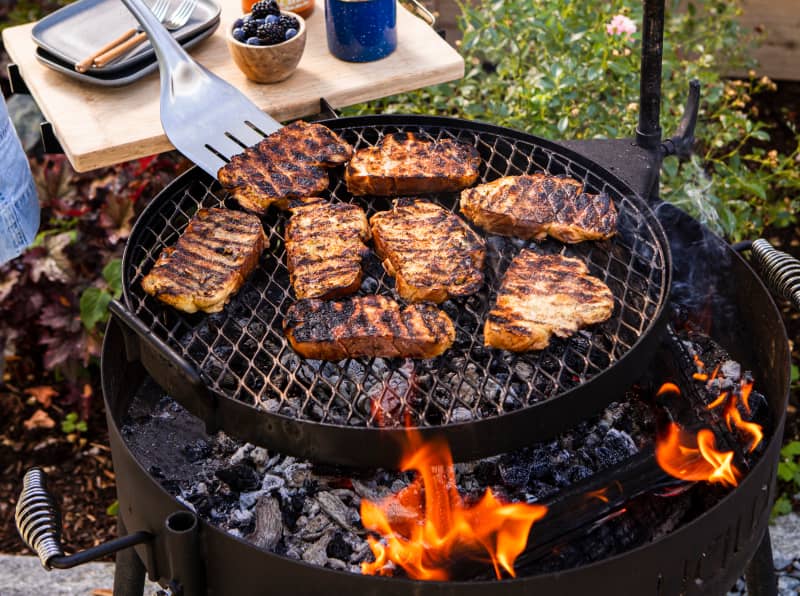
- Versatility: With both models, we loved being able to use the grill and the skillet simultaneously, as this vastly expanded both the range of things we could cook and the amount of food we could put out. It’s nice to be able to cook chicken skewers on the grill while sautéing vegetables in the skillet, for example, or to toast bread while making scrambled eggs. And while we mainly used the KUDUs as grills, we also liked that we could take each model’s legs off and use them as more conventional firepits, sitting just 4 inches off the ground, if we wanted.
We loved that both KUDUs let us cook full meals with different components simultaneously.
- They're Easy to Use: Both models make it a cinch to adjust the height of the cooking grate and skillet so that you get just the right distance from the heat, ensuring that your food cooks properly without falling prey to flare-ups. (The KUDU 3.0 has a slight edge here. While the cantilever locks take some practice to use properly, they are easier to adjust than the KUDU 2.0’s simple screw locks. They also let you adjust the grate and skillet at slightly different angles, an advantage if the ground the KUDU is on isn’t perfectly level.) You can also vary your cooking distance to help achieve different effects: Char a thick steak up close to the coals and then back it up so that it can finish cooking at a more moderate heat. We also liked the fact that with both models, we could swivel both the grate and the skillet off the fire. This let us stop the food from cooking and gave us better access to the pit itself if we needed to add logs.
- Large Cooking Grates and Skillets: The cooking grate measures about 19 inches in diameter on the KUDU 2.0 and 20 inches on the KUDU 3.0. Both are a little smaller than our favorite charcoal grill’s cooking grate, but they still provide ample room for food. In fact, because the bases of both KUDUs are flat, unlike the convex base of our favorite charcoal grill, you get more direct heat, allowing you to make better use of the entire grate. Both KUDU grates have a mesh pattern that prevents smaller food from falling into the fire. We particularly liked that the KUDU 3.0’s cooking grate sinks slightly into the shelf that holds it; the walls of the shelf prevent food from falling off the grate. The heavy cast-iron skillet that comes with the KUDU 2.0 is 16 inches wide, whereas the KUDU 3.0’s skillet is slightly smaller, at 15 inches, but is enameled on the outside for extra durability. Both provide plenty of extra cooking space.
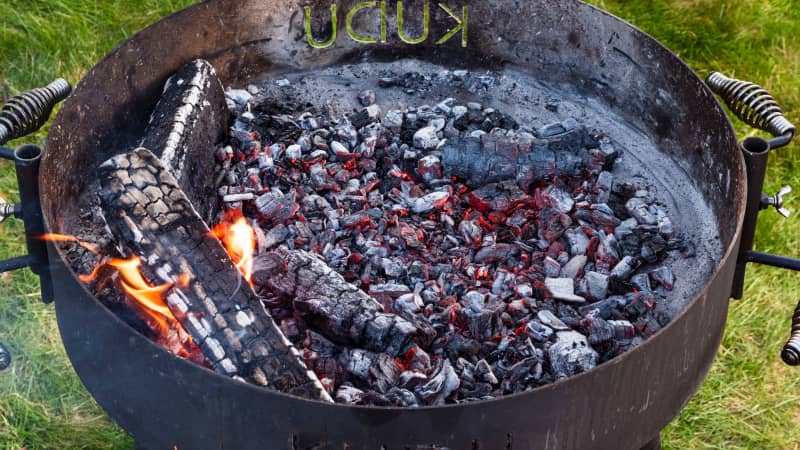
- Durability: Heavy and well-made, both the KUDUs proved to be pretty indestructible, surviving months of testing with no damage.
- Removable Coal Grate (KUDU 3.0 only): Our favorite charcoal grills have adjustable openings in their bases that allow air to flow in, actively ensuring convection. This airflow is useful for both starting and maintaining your fire, as it keeps the fire itself from stalling out. The KUDU 2.0 lacks these openings, so you’ll need to actively create room for air to circulate within its base by stacking logs so that the fire can “breathe,” receiving air from above and below. Happily, the KUDU 3.0 added a coal grate, which provided the air flow we were looking for. It doesn’t always work well with wood, as smaller pieces fall through the grate and become harder to manage, but it’s a useful feature when cooking with charcoal.
What We Didn’t Like
- They’re Really Heavy: On the one hand, we loved the KUDUs’ solid construction, which ensures a long lifespan. On the other hand, because they weigh 73 to 75 pounds, they aren’t as portable as your standard firepit; you’ll need two strong people to move it. While this didn’t stop us from taking either KUDU camping—once disassembled, the individual parts are light enough to move easily—others might think twice.
- No Ash Catcher: Neither KUDU has an ash catcher, so you’ll need to remove ash and spent logs with a shovel or dustpan.
Should You Buy a KUDU Grill?
If you think you’ll only cook over an open fire occasionally, you’re probably better off sticking with a more basic firepit. And if you’d like a grill that generates more predictable heat output—one that requires fewer adjustments to get the temperature just right—stick with a charcoal or gas grill.
But if you’d like to take a deeper dive into open-fire cooking, we think both KUDUs are great options. Neither is cheap; at $399 for the base model for KUDU 2.0 and $499 for the KUDU 3.0, you’ll be spending about the same that you would for an entry-level charcoal grill or a premium firepit. Still, both models offer good value for the money you’ll spend.


We think that both KUDUs are great options for folks who want to get serious about open-fire cooking.
Which KUDU Grill Should You Get?
Both the KUDU 2.0 and the KUDU 3.0 are fantastic grills, and we think either is a good choice. If we had to pick one, however, we’d go with the KUDU 3.0, which has a number of improvements that increase its durability and ease of use: better enamel coatings on many metal components, wider-set legs for greater stability (though we didn’t find the KUDU 2.0 to be particularly rickety!), cantilever locks that make it easier to adjust the height of the grill grate and skillet, and a coal grate for increasing airflow under your cooking fuel. That said, if you’d like to save some money, you can’t go wrong with the KUDU 2.0, which we liked nearly as much and is $100 cheaper.
The Tests
- Cook Chicken Souvlaki
- Cook Harissa-Rubbed Rack of Lamb with Ember Baked Carrots
- Cook Thick Porterhouse Steaks with Ember Baked Potatoes
- Cook Grilled Jerk Chicken
- Make breakfast (scrambled eggs, toast)
- Clean and maintain after every use
How We Rated
Performance: We rated the KUDUs on how well they cooked different foods.
Ease of Use: We evaluated the KUDUs on how easy they were to set up, maneuver, adjust, and clean.
Durability: We rated the KUDUs on how well they resisted damage and wear over the course of a year.