You’d never know from shopping at most supermarkets that there are more than the three or four types of flour available from a handful of large manufacturers. In actuality, the world of flour is vast and complex. In 2020, during the COVID-19 pandemic, flour became a rarity on supermarket shelves. Home bakers hunted down flour online or even bought it wholesale from restaurant suppliers. Regional mills that had provided flour only for restaurants and bakeries started selling directly to home bakers, which resulted in skyrocketing sales in 2020. While some home bakers reverted back to supermarket stalwarts once shelves were replenished, interest has persisted enough that mills that had packaged only 50-pound bags of flour prior to 2020 now regularly offer 5-pound versions for home cooks.


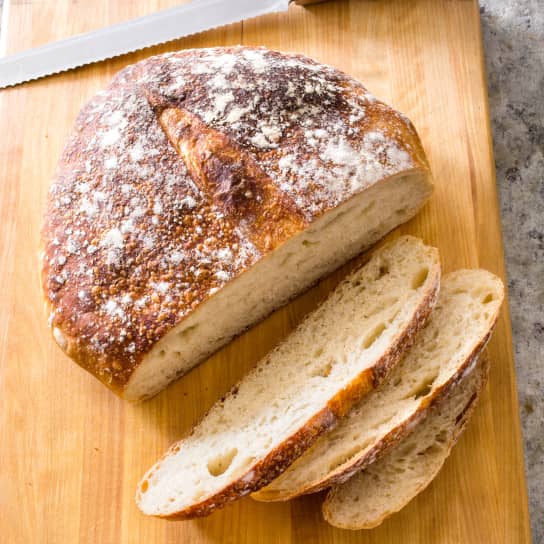
We made Almost No-Knead Sourdough Bread using high-extraction bread flour from five mills across the country.
In the United States, dozens of small mills produce high-quality flour. The flour is often labeled ‘“stone-ground” due to the special tools used to make it. Often, the flour will also be labeled “freshly milled,” but this is not a standardized term. We focused on wheat flour, but many also mill other grains such as corn and rye, other types of wheat such as spelt and einkorn, and more. We chose five mills spread across the country, ordered from each a high-extraction bread flour and a high-extraction all-purpose flour (see “A Flour Glossary” for more information), and baked with them in side-by-side tests. We also spoke to millers, bakers, and even people who are both to learn why they choose this flour and how they incorporate it into their baked goods, both at home and in bakeries across the country. Read on to learn more about stone-ground flour so that you can decide if you want to incorporate it into your baking.
Sifting/Sifted: When a bag of flour says “sifted,” it means some of the bran and germ have been sifted out. Flours labeled “100 percent whole grain” have not been sifted.
Extraction Rate: When a flour has a higher extraction rate, it means more of the whole wheat berry is included and that the flour contains more flavor and enzymes from the bran and germ. For example, whole-grain flour has an extraction rate of 100 percent. Generally, flours with extraction rates above 75 percent are considered “high extraction.”
Ash Content: Some mills use ash content instead of extraction to indicate how much of the wheat berry is retained in the flour. This number is derived by burning a small amount of flour and seeing how much mineral is left over compared to the original weight. It can be expressed as a percentage or as a type. For example, a flour that is type 85 is 0.85 percent ash. While there is no easy way to convert ash content to extraction rate, a higher number for either metric denotes less sifting, meaning the flour contains more bran and germ.
Protein Level: Protein level indicates how much gluten a dough will develop and how strong it will be. Glutenin, which provides strength and elasticity, and gliadin, which contributes extensibility, are the two proteins that make up gluten. The all-purpose flours we tested ranged from 10 to 12 percent protein and the bread flours ranged from 13 to 15.2 percent protein. In general, conventional all-purpose flour ranges from 9 to 12 percent protein and conventional bread flour ranges from 12 to 14 percent protein.
Types of Wheat:
Hard and Soft: This refers to the wheat kernel’s physical characteristics. Hard wheats tend to be higher in protein, which creates more gluten and more chew, and are great for bread, while soft wheats tend to be lower in protein and are good for pastries.
Winter and Spring: Winter wheat is typically planted in the fall and harvested in the spring and summer, and spring wheat is planted in the spring and harvested from summer into fall. In general, spring wheats are higher in protein, describes Tara Jensen in her cookbook, Flour Power (2022).
Red and White: The natural color of the wheat berry. Red wheats tends to be a little higher in protein, and Jensen describes their flavor as “peppery” and “nutty.” White wheats are typically slightly lower in protein, with a “light flavor,” says Jensen.

Bran: Bran is the outer layer of the wheat kernel; it is made of cellulose and other fiber and is highly nutritious. Bran particles can impact gluten development because the sharp fibers cut gluten strands, which is part of the reason why whole-wheat and some stone-ground flours can produce slightly more dense baked goods.
Endosperm: This inner part of the wheat kernel contains the most starch and protein. White flour is mostly endosperm.
Germ: This is the innermost part of the wheat kernel and contains the most oils and enzymes.
What Is Stone Milling?
Most flour sold in America is made using a process called roller milling. It emerged as the dominant method in the late-19th century, around the same time as the completion of the Transcontinental Railroad in the United States, which "made it possible to ship large quantities of grain across the country," writes Roxana Jullapat in Mother Grains: Recipes for the Grain Revolution (2021). These synchronous innovations, allowing flour to be produced and transported more quickly, prompted farmers to start “engineering wheat to better suit commercial flour production. They bred high-starch wheat yielding vast quantities of white flour,” Jullapat says. Stone milling, which had been around for thousands of years, became something of a lost art. Roller milling “separates the three components of the grain: the endosperm, the germ, and the bran. Steel rollers slice away the oily germ and peel off the bran, producing a white, endosperm-only flour with a long, stable shelf life,” describes Jennifer Lapidus in Southern Ground: Reclaiming Flavor Through Stone-Milled Flour (2021). It’s an important difference from stone milling, which does not remove the germ but rather finely grinds it and intersperses it throughout the flour. Stone milling also does not automatically remove the bran; it is optionally sifted out later on.


The furrows (the grooves in the stone), break the wheat into smaller pieces and the lands (the flat parts) grind the pieces into a fine powder (left). The stone sits in a fully assembled flour mill (right). (Photos courtesy of New American Stone Mills; Credit: Blair Marvin)
One company helping to repopularize stone milling is New American Stone Mills. Based in Elmore, Vermont (where the owners also operate Elmore Mountain Bread), the company manufactures granite stone mills for flour mills and bakeries across the country, including Ground Up Grain in Holyoke, Massachusetts. The bottom stone, or bedstone, of the mill is stationary, and the top stone, or runner stone, rotates 200 to 300 revolutions per minute. An auger feeds grain into the eye of the stone. The grooves in the stones, called furrows, “move the grain between the stones and criss-cross, working to break the grain into smaller pieces,” said Andrew Heyn, founder of New American Stone Mills. “The flat parts of the stone, called the lands, are rough and they grind from little pieces down into powder,” Heyn explained.
“The amount of pressure between the stones is part of the formula” to create the desired characteristics of the flour, said Andrea Stanley, co-founder of Ground Up Grain, as are the speed of the stone’s rotations and how quickly the grain falls into the stone. Stone milling also keeps the grain at a cool temperature, which helps retain its nutrients. After milling, the flour is sifted to varying degrees depending on the intended end product.
How Is Stone-Ground Flour Different from Conventional Flour?
Stone-ground flour has an “intensity of aroma and flavor,” said Joshua Bellamy, founder and owner of Boulted Bread in Raleigh, North Carolina. When used in baked goods, it “creates a rounder, fuller flavor in your mouth.” While most of the mills we looked at offer several kinds of flour, we focused on what’s called high-extraction flour, which means that more of the bran and germ are retained in the final product. This type of flour is very different from the typical white flour available in supermarkets, which has most of the bran and germ removed. The extraction rates of the flours in our lineup ranged from 80 to 85 percent, whereas the extraction rate of average supermarket white flour, according to flour vendor Grist & Mill, ranges from 45 to 72 percent, depending on whether it’s all-purpose, bread, pastry, or cake flour. The extraction rate of whole-wheat flour is 100 percent. Some companies instead list ash content, a technical metric that measures the mineral content of flour and conveys similar meaning: A higher ash content means more bran and more germ. The ash contents of the products we tested ranged from 0.85 to 1.4 percent. Conventional white flour has an ash content of around 0.5 percent, whereas the ash content of whole-wheat flour can reach 2 percent.

High-extraction stone-ground flour looks very different compared with white flour, but high-extraction flours can also look very different from each other. The flours from Ground Up Grain, for example, had a more heterogeneous texture with visible flecks of bran. The Carolina Ground flours were more golden and felt gritty when we ran them through our fingers. Even when they had a more uniform appearance, the flours had an almost creamy look and feel, because the oily germ is also evenly spread throughout, as was especially noticeable with the Cairnspring Mills flours.


Even within stone-ground flours, there was a wide array of textures and colors. The bread flour from Cairnspring Mills (left) was a creamy off-white color with small flecks and the bread flour from Carolina Ground (right) was grittier with a more golden appearance.
Additionally, as with other small-batch products, there’s natural variation from “batch to batch or crop to crop,” said Greg Wade, head baker at Chicago’s Publican Quality Bread and author of Bread Head (2022). Large industrial roller mills source grain from across the country to achieve the perfect blend for their product and therefore reliable consistency. Because farmers and millers operate on a much smaller scale, Heyn likens using stone-ground flour from artisan mills to working with seasonal produce. “You need to make the bread suit the flour, not the flour suit the bread,” he said.

You need to make the bread suit the flour, not the flour suit the bread.
—Andrew Heyn, founder of New American Stone Mills
The bakers and millers we spoke to explained that high-extraction bread flour tends to be more active (meaning that doughs made with it will ferment more quickly) and thirstier (so you may need to add more water). When making yeasted doughs or sourdough recipes, the fermentation process will likely be a little quicker than you’re used to with more refined flour. Daisy Chow of Breadboard Bakery in Arlington, Massachusetts, uses flour from Ground Up Grain and from Elmendorf Baking Company in Cambridge, Massachusetts. The dough she makes with it proofs “a little faster because it has more nutrients, a little more bran, more of everything that’s good to kick-start the sourdough,” she said. Andrew Janjigian, former Cook’s Illustrated editor and author of the Wordloaf newsletter, explained that this is because “many of the enzymes of the grain are in the germ.” Your bread can “overproof, it can get too sour. The yeast is going to have more access to the starches and the sugars than it would otherwise,” he said.

What to Know About Baking with Stone-Ground Flour
With the experts’ advice in mind, we set out to bake our recipe for Almost No-Knead Sourdough Bread 2.0 with each bread flour purchased from the five artisan mills. For comparison, we made the same recipe using bread flour from King Arthur Baking Company. We proofed all the doughs for roughly the same amount of time, did not modify the hydration levels, and used the same starter for each. Because the artisan flours contained varying levels of bran and germ, the doughs behaved very differently as we mixed them, as they rose, and as they baked.
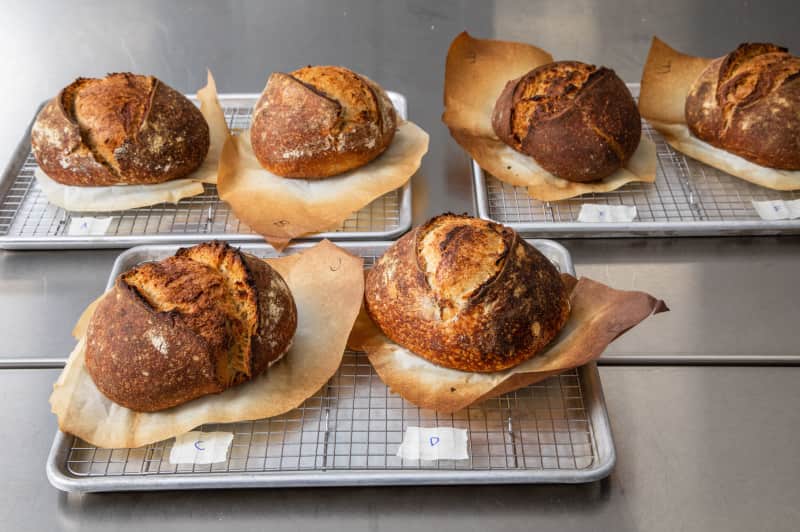
The dough made with Cairnspring Mills bread flour was a bit puffier than others. This may have been a result of its mid-range ash content, indicating it had enough germ to boost fermentation but not too many large bran particles to inhibit gluten development. The dough made with King Arthur bread flour rose more slowly and was the last to finish fermentation, but only by 30 minutes or so. Overall, the crumb of the doughs made with high-extraction bread flour was noticeably tighter and had a drier texture than the loaf made with King Arthur bread flour, which was a bit more airy, open, and moist. All the loaves made with stone-ground flour had more complex flavors, and some, such as the loaves made with Barton Springs and Carolina Ground bread flour, had particularly strong “malt” and “bran” notes. While some tasters appreciated these rich, grainy flavors, a few tasters preferred the loaf made with King Arthur and its familiarly mild, lighter-colored crumb.

Next, we made our recipe for Easiest-Ever Biscuits using the stone-ground all-purpose flours. When using high-extraction flour in baked goods that don’t contain yeast, such as biscuits, the high concentration of enzymes and nutrients doesn’t have as much of an effect. However, it was clear that the flours were different from the ones we normally use. The biscuits we made with the high-extraction all-purpose flours had a grainier, heartier flavor than those made with King Arthur all-purpose flour, which tasters found “mild” and “pale.” Some biscuits, such as those made with flour from Carolina Ground, had a slightly sandier texture as a result of the flour’s higher extraction rate and a bit more bran. But all were plenty moist and rich, likely due to the fat from the substantial amount of heavy cream in the recipe. In general, the more ingredients a recipe has, the less pronounced the effects of high-extraction flours will be.


We made six batches of our Easiest-Ever Biscuits to test high-extraction all-purpose flours from mills across the country.
Every flour and every recipe is different, so take your time and tinker to find your desired result. When baking in hotter or more humid weather, bakers must rely on visual cues to see how quickly their dough is rising, and the same is true for baking with stone-ground flour. The higher activity can be controlled by fermenting doughs for shorter periods of time or doing so in a slightly cooler environment. Janjigian recommends starting with a 5 percent increase in hydration when using high-extraction, stone-ground flours. Wade suggests increasing the length of time for autolyse, the roughly 20- to 60-minute period of letting a dough rest after mixing the flour and water, to allow the flour to absorb more water and fully hydrate it.
How to Shop for Stone-Ground Flour
All the flours we tried are available online. Start by looking for a mill near you (we especially like the website Grinder Finder). Also, be on the lookout for stone-ground flours at specialty food stores, bakeries, and farmers’ markets. If you want more hearty grain flavor, look for something with a higher extraction rate or ash content. If you prefer the plush texture and neutral flavor of bread made with white flour but want to branch out a little, you’ll want those numbers to be lower, such as the flours from Cairnspring Mills.
Whether buying locally or online, purchase only what you’ll reasonably use in a few months. While the germ contributes flavor and nutrition to stone-ground flour, it also gives it a shorter shelf-life than conventional white flour, as the oils in the germ can cause the flour to go rancid more quickly. Excess flour can be stored in the freezer if necessary.

How Long Does Flour Keep?
Different types of flour last longer on the shelf than others. Here’s how to keep them fresher for longer.
Learn MoreWe encourage you to refer to our glossary at the top of the page and the chart below. Because these flours are often bolder in flavor and require more attention and adaptation to achieve the best results, they aren’t for everyone. We suggest starting with bread flour, as that’s where we noticed the most stark differences compared to conventional white bread flour—both because it highlights the flour’s heartier qualities and because it’s more often used in recipes where the flour plays a starring role. However, we’re confident that experienced bakers and people who want to shop locally will find both bread and all-purpose stone-ground flours fun and rewarding to bake with. All the flours we tried are excellent, so we did not choose a favorite. Instead, we’ve listed them alphabetically and provided tasting notes from our baking tests to help you find which one might be best for you and your baking endeavors.
- Taste bread flours in Almost No-Knead Sourdough Bread 2.0, using the same starter for each
- Taste all-purpose flours in Easiest-Ever Biscuits