
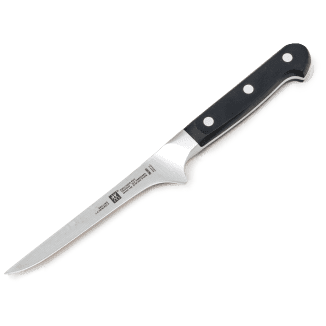


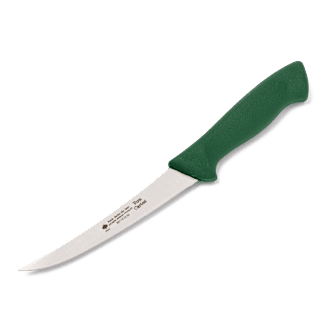

The best boning knives have sharp, moderately flexible blades and comfortable handles. Our longtime favorite is the Zwilling Pro 5.5" Flexible Boning Knife, which features a razor-sharp and incredibly nimble blade. We have two Best Buys: the Friedr. Herder Don Carlos 6" Boning Knife Curved Flex Stainless Green and the Victorinox Swiss Army Fibrox Pro Boning Knife. Both are much more utilitarian than our top choices and have larger, thicker handles, but they perform very well for their lower price, making them excellent options for home cooks on a budget.

A boning knife can be a useful addition to your knife collection. It’s a butcher’s tool with a thin, narrow blade that’s designed to shimmy and slice between joints or carve around bigger bones. We use it most often for minor butchery—deboning chicken breasts or chicken thighs, for example. Deboning these cuts at home can save you money at the supermarket, since bone-in meat is usually less expensive than boneless cuts. (The bones you extract are a bonus, giving you a little something to add to your stock pot later on.) And because we often use these knives to prepare expensive cuts—scoring the skin on duck breasts, removing the silver skin from a beef tenderloin, or frenching a rack of lamb—a good boning knife can also help protect your investment, hewing closely to the bone and allowing you to trim away only what you don’t want, with little or no waste. In a pinch, of course, you can always use a paring knife for any of these tasks, but we’ve found the longer, more flexible boning knife blade to be a bit more handy overall. Its length means it can carve out both small bones and bigger ones, such as the one found in a roast pork shoulder, and its flexibility makes it more agile. Finally, a lot of cooks in the test kitchen also prefer to use a boning knife to break down cooked roast chickens; that narrow blade does an especially fine, precise job of separating the whole into parts.


We use boning knives for a variety of tasks, including scoring the skin on meat and poultry and removing the bones from cooked roasts.
Boning knives come in different lengths and levels of flexibility: stiff, semistiff, semiflexible, and flexible. Each type and size excels at different tasks, but we’ve found the 6-inch flexible boning knife to be the most versatile option for home cooks.
What to Look for
- Sharpness: Because the blade of a boning knife is comparatively light, thin, and narrow, it can’t use its heft to force food apart the way a chef’s knife can. Instead, it relies almost entirely on the sharpness of its edge—particularly at the tip—to slice, trim, or make incisions. Sharpness is determined in part by edge angle, the angle of the blade on either side of its cutting edge. The narrower the angle, the thinner the cutting edge and the sharper the knife can feel in action. In general, we preferred models that had narrow edge angles of 14 or 15 degrees. That said, edge angle isn’t the only factor in a blade’s sharpness. In practice, the keenness of any blade is often determined by how well it has been sharpened and honed at the factory. The best blades were nicely finished and thus razor-sharp right out of the box.

- Moderately Thin, Flexible Blades: As the knife’s name implies, flexibility is also important. Unlike a chef’s knife or paring knife, a flexible boning knife has to have a certain degree of give so that it can bend and maneuver around bones, cartilage, and joints. Although all the knives in our lineup were marketed as “flexible,” the actual flexibility varied from model to model depending on the thickness of the blade’s spine. Some blades had thick spines measuring around 2 mm and were more rigid as a result—they couldn’t hug the breastbone on a piece of chicken or the bone in a pork shoulder quite as closely and consequently left more flesh behind. Others had spines that were a bit too thin and flexible and thus harder to control; at times, these knives felt dangerously slippery. We preferred blades that had a moderate level of flexibility, with spines measuring about 1.25 mm thick. These allowed for nimble but precise cuts with little or no wasted meat.


Blades that were very thin and flexible (left) were sometimes a little hard to control. But blades that were thicker and more rigid (right) didn’t hug the curves of meat and bones as closely, removing more precious meat.
- Medium-Thick, Grippy Handles: Most of the models’ handles measured about 4.5 inches long, providing plenty of room for small and big hands to grip. Handle circumference proved more controversial. Unlike a chef’s knife, a boning knife is often held with your pointer finger on the spine for added control when directing the blade. In this context, a thicker handle can make for less dexterous maneuvering, and a slightly thinner handle can be an advantage, allowing users to switch their grip more readily. We preferred handles that were relatively slender, measuring about 2.75 inches around at their thickest part. These were comfortable for hands of all sizes to hold. We also liked handles that were made of textured, rubbery materials; slicker handles made it harder to maintain our grip when dealing with wet or greasy meat.

Other Considerations
- Blade Length: Most of the models we tested had usable blade lengths of 6 inches, as advertised. A few were slightly longer and one, our winner, was half an inch shorter. All the models were deemed acceptable by our testers. And in practice, many testers found they preferred the winner’s shorter 5.5-inch blade length, as it gave them a little more control for precise cuts, though it was a little undersized for carving out the big shoulder bone in the pork roasts we cooked.
- Blade Curvature: The blades on boning knives can be either straight or curved like a scimitar. We had a slight preference for blades that were fairly straight, as we found it a bit easier and more natural to direct the point of the blade where we wanted it to go. Curved blades had their fans, too, though, with some testers noting that the curve made it easier to apply leverage when slicing through a cut using the tip or front section of the blade. Ultimately, the choice is personal.

- Weight: We didn’t have significant preferences when it came to the weight of the knives, which ranged from about 2.7 to 4.8 ounces. Our top pick is one of the heavier models, and our Best Buys two of the lightest. All were easy enough to wield even for longer sessions.
The Tests:
- Evaluate each knife’s sharpness using an industrial sharpness-testing machine at the beginning and end of testing
- Remove bones from 2 chicken breasts
- Trim silver skin and fat from beef tenderloin
- Remove bone from cooked pork shoulder roast
- Have cooks of different dominant hands and hand sizes remove bones from chicken breasts and french racks of pork
How We Rated:
- Sharpness: We rated the knives on how sharp they were before, during, and at the end of testing.
- Blade: We evaluated how easily the knives performed different tasks, considering the length, curvature, spine thickness, and flexibility of their blades.
- Handle: We rated the knives on how comfortable they were for hands of different sizes to hold.