

 Buy at Amazon
The best handheld vacuums prioritize portability and convenience without sacrificing suction power or efficiency. They’re ideal for tackling small to moderate messes and getting into hard-to-access areas. Our winner, the Black + Decker 20V MAX Cordless Pivot Vac, has a unique pivoting nozzle that allows you to easily navigate under furniture or below car seats. Its impressive suction tackled every mess we tested it on, and we were especially impressed with its ability to pick up pet hair. We also liked the Black + Decker DUSTBUSTER Hand Vacuum, which is lighter than our winner and only marginally less effective. It excelled in suction tests and sports a narrow nozzle that is especially adept at reaching into tight corners.
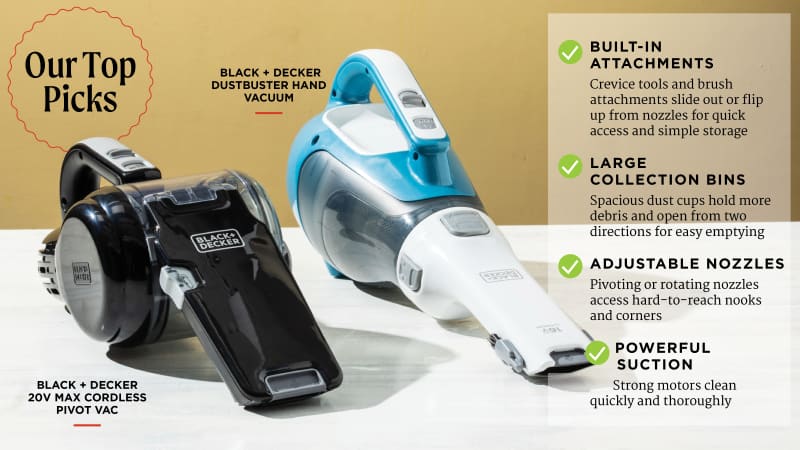
Handheld vacuums are relatively compact, lightweight, and portable. Most models don’t need to be plugged in while you use them, giving you the freedom to move around the house or out to your car. They charge using docking stations or power cables. They all come with one or more attachments, including narrow crevice tools for cleaning tight corners or between sofa cushions and brushes meant to dislodge and scrape up pet hair. The best models made cleaning our homes, cars, and office easier, and we found a few factors that set them apart.
What to Look For
- Powerful Suction: Our favorite models were impressively powerful and efficient, usually taking less than 30 seconds to completely clear a 1.5 foot–square section of carpet of 100 grams of dirt, uncooked rice, pet hair, and onion peels.

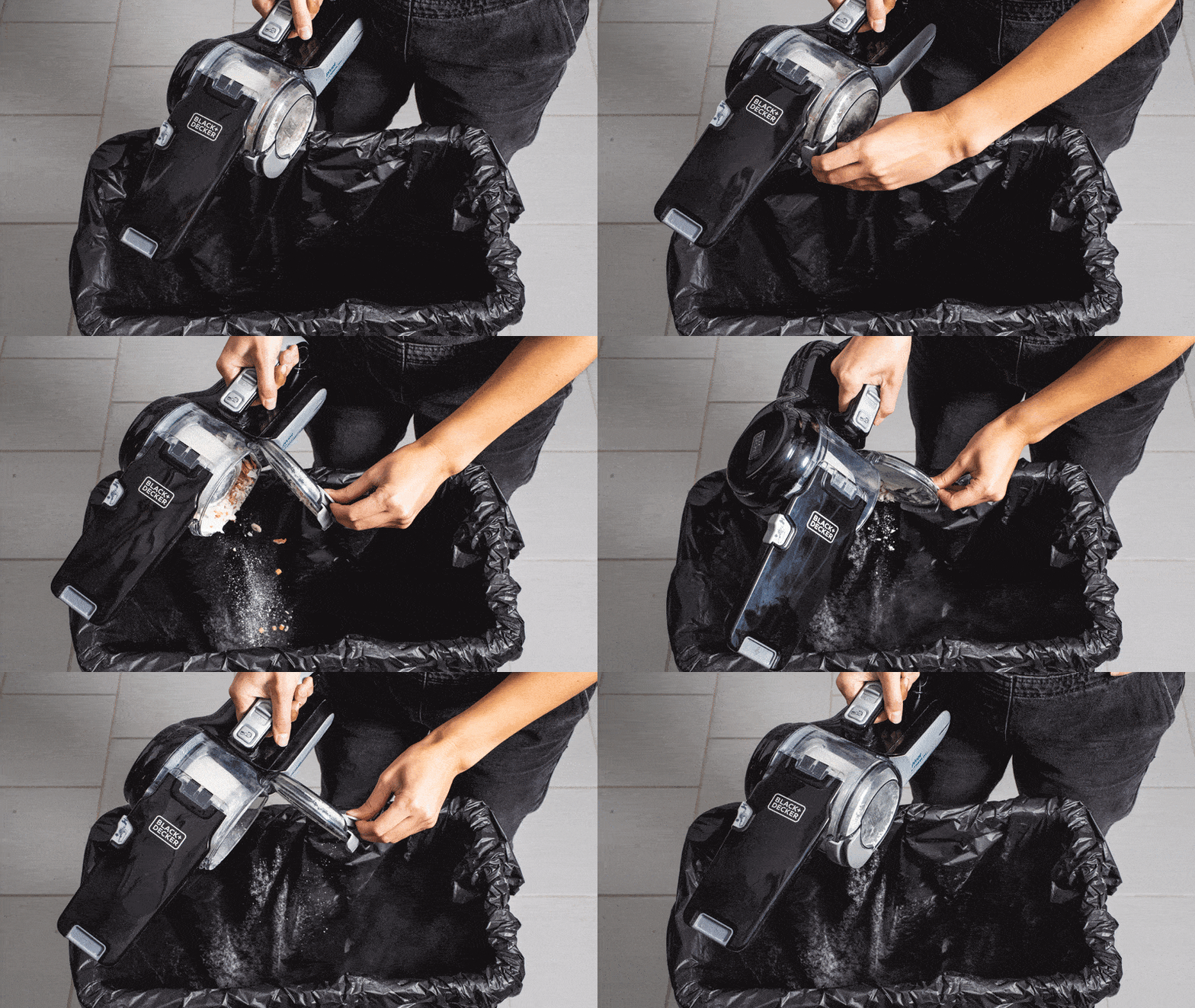
- Spacious, Easy-to-Empty Collection Bins: We preferred large collection bins that allowed us to vacuum up big messes in one fell swoop. We also liked bins that were easy to open and empty. It was faster and less messy to press a single button or pull a small latch and pour, rather than fully detaching a bin and removing a filter.
- Moderately Sized Models with Customizable Nozzle Lengths: We preferred streamlined, relatively narrow models that were no longer than 17 inches without attachments. This allowed for easy maneuvering in tight confines. Our favorite models had crevice attachments that increased the length of the machines by 4 to 5 inches, allowing us to reach up into window corners or down into lower cabinets.
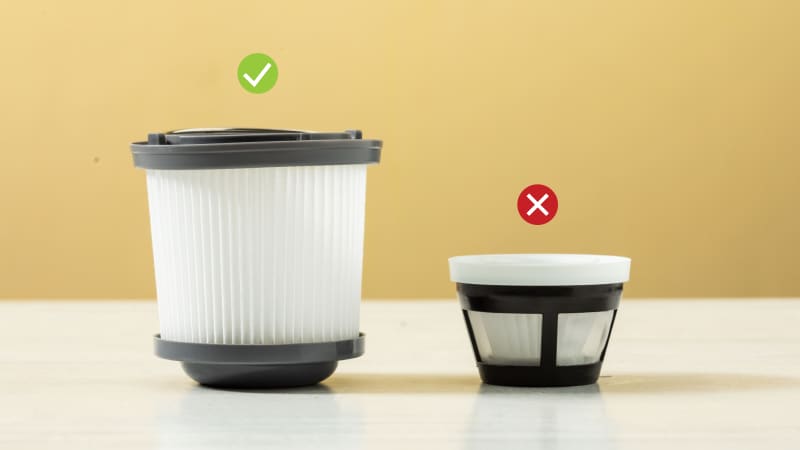
- Large, Cup-Shaped Filters: The best vacuums had large, cup-shaped cloth filters that were at least 3 inches in diameter and 3 inches deep. With more surface area for air to pass through, they clogged less frequently than smaller filters.
- Mounted Attachments: We preferred models with attachments that were either built into the vacuums’ nozzles and slid out or flipped up for use or were otherwise stored on the bodies of the vacuums. A few other models’ attachments were stored on their charging bases, which wasn’t quite as handy but was preferable to having loose attachments.


We preferred models with attachments that were mounted on the vacuums' bodies for easy access and storage. Flip-up brushes (left) and pull-out crevice tools (right) were both effective and convenient.
Nice to Have
- Pivoting or Rotating Nozzles: Some of the vacuums we tested had adjustable nozzles, which helped us access otherwise unreachable areas without contorting our wrists or straining our arms. Our favorite model’s nozzle pivoted 220 degrees around its collection bin, allowing us to customize the angle from which we approached messes, and its body and nozzle folded together like a book for easy storage.

What to Avoid
- Weak Suction: A few models simply weren’t powerful enough to pick up every mess. Weaker models took more time to clean up pet hair, cereal, and other household debris, often requiring multiple passes over the same area.
- Small or Complicated Collection Bins: Bins with small capacities filled up too quickly, forcing us to stop midcleaning to empty them. Some couldn’t even hold ½ cup of uncooked rice. We also had to remove the filters of some models before we could empty their bins. That extra step slowed us down and got our hands dirty.
- Bulky or Overly Long Designs: Vacuums that were boxy, bulky, or too long were cumbersome. They foundered in smaller spaces such as car floorboards, defeating the purpose of buying a smaller machine.
- Small, Easily Clogged Filters: Smaller filters clogged faster, forcing us to empty and clean the machines more frequently.
- Loose Attachments: Vacuums or charging stations that didn’t have places to mount and store attachments were less convenient. In many households, having to keep up with loose attachments or store them separately is a recipe for never seeing them again.
Other Considerations
- Weight: The most powerful and efficient models we tested tended to be heavier, and our favorite model was the second-heaviest in the lineup. Its weight tired some testers faster than others and can be a legitimate obstacle to cleaning. If you’re worried about weight, we suggest purchasing our runner-up, which is about 5 ounces lighter than our winner and nearly as effective.
The Tests:
- Starting with full batteries, run each vacuum until battery loses power, noting runtime
- Charge spent batteries, noting charging time
- Clean ditalini from carpet, noting elapsed time
- Clean dry cereal from carpet, noting elapsed time
- Clean baby powder from carpet, noting any filter blockage
- Clean a mixture of uncooked rice, soil, onion peels, and pet hair from carpet, noting elapsed time
- Clean a mixture of uncooked rice, soil, onion peels, and pet hair from hardwood floors, noting elapsed time
- Clean pet hair from upholstered sofa, using pet/upholstery tools when applicable
- Using crevice tools, clean under kitchen and bathroom cabinets and behind bathroom sinks
- Using crevice tools, clean car seats and floorboards
- Have additional testers clean ½ cup of uncooked rice from carpet, with and without crevice tools
- Use vacuums for four weeks with routine filter cleanings, noting any durability issues
- Open and close collection bins 50 times
- At conclusion of testing: Starting with full batteries, run each vacuum until battery loses power, noting any changes to runtime from initial tests
How We Rated
- Performance: We tested how effectively the vacuums cleaned up an assortment of messes from a variety of surfaces and locations.
- Handling: We assessed how comfortable the vacuums were to hold and maneuver.
- Ease of Use: We evaluated how easy it was to disassemble, empty, clean, and reassemble the vacuums and whether their controls were simple to operate. We also tested how easy it was to install and detach their attachments.
- Durability: We assessed how well the machines held up to long-term use and if they sustained any damage from abuse testing.