

 Buy at Amazon
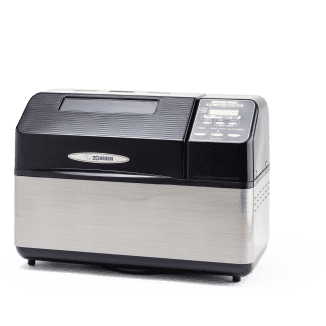
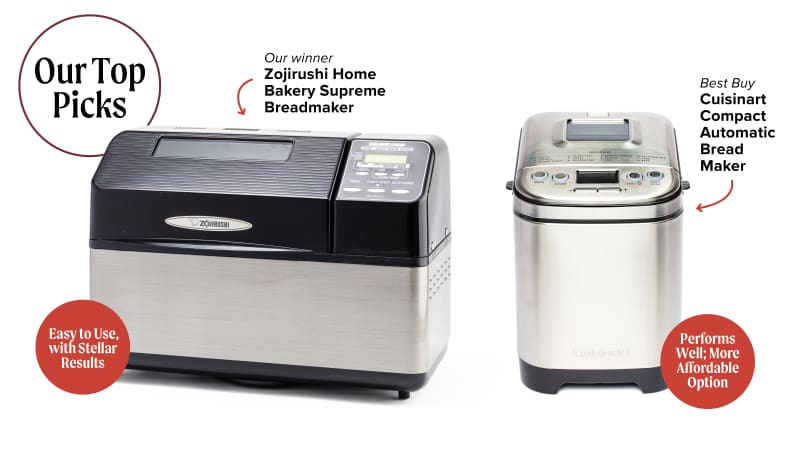
While some might thumb their noses at the idea of a machine taking over the time-honored process of making bread by hand, bread machines can produce a variety of stellar loaves: white bread, sweet bread, dense and chewy rye, babka swirled with chocolate, and more. They are great for those who love freshly baked bread but don't have the time or energy to devote to hand-formed boules. The Zojirushi Home Bakery Supreme Breadmaker was easy to use and consistently baked gorgeous, even-crumbed loaves of bread. Its higher-end counterpart, the Zojirushi Home Bakery Virtuoso Plus Breadmaker, also baked impressive loaves, though the control panel was slightly less intuitive. We also chose a Best Buy, the Cuisinart Compact Automatic Bread Maker. Overall, it produced loaves with remarkably even crumbs and a moist, fluffy texture, but it sometimes struggled with larger loaves on settings with longer proof times.
At its most basic, a bread machine automates the process of baking a loaf of bread. Just add the ingredients in the order called for in the recipe, pick your settings and preprogrammed cycle, and press “start.” A few hours later, a beautiful loaf of bread emerges.
The machine takes care of the mixing and kneading and also has timed rest and “punch-down” intervals that vary depending on the type of bread. In addition, you can select your desired crust shade: light, medium, or dark. The most basic loaves take about 3 hours to make, from start to finish.

Want bread in a jiffy and with minimal effort? A bread machine makes it possible. Just add the ingredients in the order called for in the recipe, pick your settings and preprogrammed cycle, and press “start.” A few hours later, a beautiful loaf of bread emerges.
All the machines we tested had the ability to make 2-pound loaves, though some also had options for other bread sizes, ranging from 1- to 2.5-pound loaves. Most store-bought bread comes in 1-pound loaves, but we found that most bread machines came in bigger sizes. All the bread machines had preprogrammed cycles, including ones for baking basic white and wheat breads, and beepers that signaled when it was time to add any mix-ins such as nuts and/or dried fruits. A few machines that we tested featured an automatic nut and fruit dispenser that added the mix-ins to the dough at the appropriate time.
We made a variety of breads in each machine: basic white bread from each machine’s recipe booklet, our recipe for basic wheat bread for bread machines, and our recipe for sweet bread with almonds and dried cherries for bread machines. After the first few rounds of bread making, we did some further baking in our favorite machines.


To further test our preferred machines, we made each machine's recipe for raisin bread (from left to right: Zojirushi Home Bakery Supreme Breadmaker, Zojirushi Home Bakery Virtuoso Plus Breadmaker, Hamilton Beach HomeBaker 2 Lb. Breadmaker). The results, consistent with previous loaves, were perfectly shaped and sturdy yet tender and had an even distribution of mix-ins.
Consistent results turned out to be the key factor that separated great bread machines from OK ones. We were especially impressed by the two Zojirushi bread machines, whose loaves were consistently picture-perfect. They had airy but sturdy interior crumbs and were the perfect shapes for a sandwich or piece of toast. While one Zojirushi model produced crusts that were slightly lighter than the medium shade selected, the results were still delicious. In contrast, some machines we tested made decent loaves one day and unsightly ones the next. We also had issues with some machines making breads that were too light and feathery; they fell apart when cut.
What to Look For
- Good Performance: Our favorite bread machines made loaves of various sizes and types with golden-brown exteriors and tender, even-crumbed interiors from edge to edge.
- Simple Interface: The best bread machines had clear control panels that made it easy to start the machine and to select the type, shade, and size settings.
- Machines with Two Kneading Paddles: In general, we found that machines with two paddles integrated ingredients more thoroughly and resulted in more evenly shaped loaves. That said, a single paddle was fine for machines with slightly smaller, cube-shaped bread pans, such as our Best Buy; it was able to reach more of the dough to combine ingredients evenly.

Bread machines come with a bread pan and at least one kneading paddle. We generally preferred machines with two kneading paddles, since they integrated ingredients better and resulted in a more evenly shaped loaf.
Nice to Have
- Automatic Fruit and Nut Dispenser: This feature, which drops in mix-ins such as fruit and nuts automatically, is helpful for those who want to start the machine and walk away.
- Viewing Light: One machine in our lineup featured a viewing light that helped us examine the bread throughout the entire process.

Each machine had a viewing window and control panel. While we liked the idea of a viewing window, they often fogged up, making it difficult to see inside. Regarding control panels, the best ones were intuitive to use with simple, clear interfaces.
- Heated Lid: One of our favorite machines featured a heated lid, which ensured an even-colored and nicely browned crust every time.
What to Avoid
- Poor Performance: Some bread machines produced misshapen loaves with pale, unattractive exteriors and gummy, dense crumbs. Others were inconsistent, making decent-looking loaves of bread followed by loaves with punched-in tops and fragile interiors that then fell apart when cut. This was likely related to the proofing time and/or temperature.


Our favorite machines produced sturdy, even-crumbed loaves that didn't fall apart when cut. In contrast, some machines produced feathery, light loaves that shredded when we sliced them. We suspect this was likely related to the proofing time and/or temperature.
- Collapsible Kneading Paddles: The mixing paddles of most bread machines remain embedded in the bread as it bakes, leaving small indentations on the bottoms of the finished loaves. One of the machines we tested had a kneading paddle that was supposed to collapse after the last rise so that it wouldn’t leave an indentation as the bread baked. While a nice idea, the paddle was difficult to keep upright when inserted into the bread pan, and it didn’t always collapse before the baking cycle started.
- Complicated Interface: A few machines had confusing control panels that made it difficult to select the correct bread type, shade, and size settings.


The Zojirushi machines' bread pans were longer and less tall than some of the other pans, producing more traditional-looking rectangular loaves (left). While we loved our Best Buy, its bread pan was taller, resulting in tall loaves that made for some big sandwiches (right).
Other Considerations
- Long Loaves vs. Cubic Loaves: Our winner’s bread pan was longer and less tall than some of the other pans, so it produced more traditional-looking rectangular loaves. In contrast, the pans of the other machines had similar heights and widths, so they made more cube-like loaves. Both styles can make great bread, so the kind you choose is ultimately a matter of personal preference.
- Make each machine’s recipe for basic white bread
- Bake our recipe for basic wheat bread for bread machines (converting the recipe to make a 2-pound loaf)
- Bake our recipe for sweet bread with almonds and dried cherries for bread machines (converting the recipe to make a 2-pound loaf)
- Bake two additional basic loaves (raisin bread from each of the machines’ cookbooks) in our favorite machines
- Soak the bread pans and wash them with soap and a sponge